
How Do You Know If a Client Retainer Is Profitable?
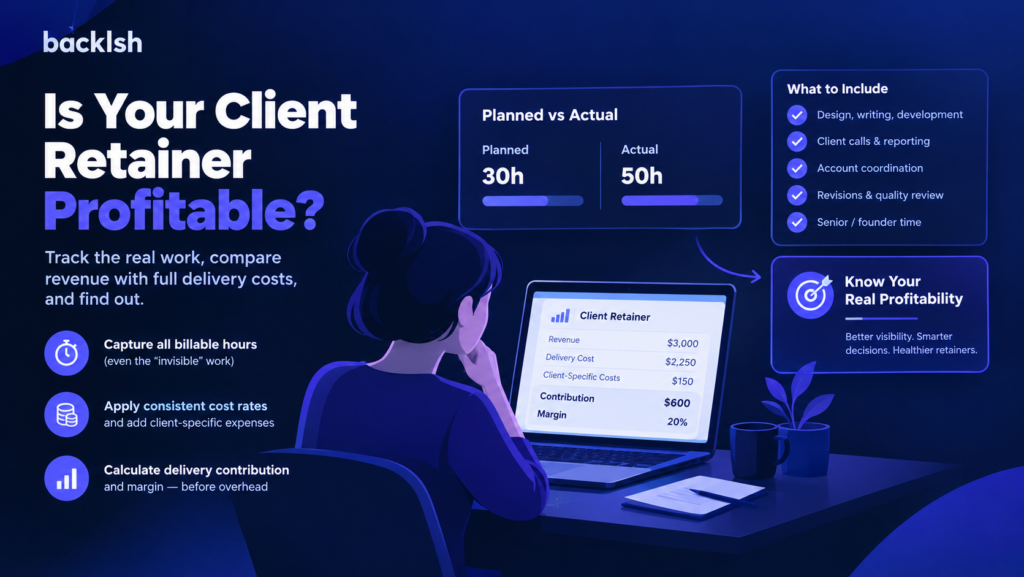
To find out whether a client retainer is profitable, compare its revenue with the full cost of delivering the agreed work. Record the hours contributed by everyone on the account, apply a consistent delivery-cost rate, add client-specific expenses, and review what remains before general overhead.
A paid invoice shows that revenue arrived. It does not show whether the account used more capacity than you priced into it.
The retainer that looked healthy until the hours were counted
The following story is fictional. The agency, client, dialogue and figures illustrate a common operating problem; they are not a Backlsh customer case study.
Maya runs a small marketing agency. One client pays $3,000 every month, approves invoices promptly and seems pleased with the work. When Maya reviews the revenue list, the account looks dependable.
The original monthly plan includes eight social posts, one report and one review call. The team budgets 30 delivery hours.
Over time, the requests change. There is another call before a launch. A second stakeholder asks for a new revision round. The monthly report becomes a presentation. None of the requests seems large enough to reopen the agreement.
At the weekly planning meeting, the designer cannot fit another client into the schedule. Maya initially wonders whether the work is taking too long. Instead of asking the designer to work faster, she reviews the account’s recorded effort.
The retainer used 50 hours that month: design, reporting, meetings, coordination and revisions. The invoice is still $3,000.
The issue is now specific. The client is receiving a larger service than the agency planned to deliver. Maya needs a scope decision, not a vague conversation about everyone being busy.
How do you calculate retainer profitability?
Start with a consistent reporting period and cost definition:
Delivery contribution = retainer revenue − delivery labor cost − client-specific costs.
Delivery contribution margin = delivery contribution ÷ retainer revenue × 100.
This is a management calculation before general overhead and other costs not already included. It is not the agency’s net profit. If your labor rate already includes an overhead allocation, avoid adding that cost twice.
Using Maya’s illustrative account, assume delivery labor costs an average of $45 per hour and client-specific tools cost $150 per month.
| Monthly measure | Original plan | Actual delivery |
|---|---|---|
| Retainer revenue | $3,000 | $3,000 |
| Delivery hours | 30 | 50 |
| Labor cost at $45/hour | $1,350 | $2,250 |
| Client-specific costs | $150 | $150 |
| Contribution before general overhead | $1,500 | $600 |
| Contribution margin | 50% | 20% |
| Revenue per delivery hour | $100 | $60 |
Twenty additional hours reduced the account’s delivery contribution by $900. That is a calculation under these assumptions, not a claim about typical agency results.
Revenue per hour is a useful warning signal, but it is not profit per hour. Different staff costs, contractor fees and service requirements can change the result.
Which hours should you include?
Include the work required to service the account, even when it cannot appear as a separate invoice line:
- Design, writing, development and analysis.
- Client calls, preparation and reporting.
- Account coordination and internal handoffs.
- Revisions, corrections and quality review.
- Founder or senior specialist time that would otherwise disappear from the record.
Classify the cause of extra effort separately. Approved additional scope, avoidable rework and included service are different business problems. See our billable versus non-billable hours guide.
If people share an application across clients, review the project assignment. Automatic capture can help collect activity, but it cannot independently determine the commercial meaning of that work.
What published agency case studies show
These are vendor-published customer accounts, not independent experiments. They describe practices worth considering; they do not establish that another agency will obtain the same results.
Dovetail: make retainer balances visible
In Harvest’s Dovetail customer story, clients buy monthly hours that can roll over. The agency combines time data with other information to report on hours used and remaining, including client-facing breakdowns. The relevant lesson is to make an ongoing allowance visible rather than relying on memory.
Turnstyle: use delivery history in scope and pricing discussions
Harvest’s Turnstyle story describes a creative agency using historical effort to assess budgets, support scope changes and revisit web-design pricing. It also emphasizes framing time records as business information for better decisions. The story does not provide a percentage improvement in profit.
Invanity: review workload and account economics together
Teamwork’s Invanity case study describes combining time records, cost rates, budgets and capacity planning. Teamwork reports 50% less time spent building project plans and 80% less time spent on weekly workload management. Those are reported operational improvements, not profit-margin increases.
Should you increase the price or reduce the scope?
First establish why delivery changed. A poor original estimate, repeated agency errors and an expanded client service should not all lead to the same response.
In Maya’s fictional example, the next client review starts with a short comparison:
| Agreed service | What changed | Decision needed |
|---|---|---|
| One monthly call | Weekly calls | Keep weekly contact with revised capacity, or return to monthly |
| One revision round | Three rounds | Agree a revision limit and process for additional rounds |
| Monthly report | Report plus presentation | Choose the priority deliverable or quote the expanded service |
She can offer three paths: keep the existing fee and return to the original service; agree a revised fee for the expanded service; or exchange a lower-priority deliverable for the new request.
For illustration, $4,000 of revenue against the same $2,400 of delivery costs would leave $1,600 of contribution, or 40%, before general overhead. That does not establish the right market price or the client’s willingness to pay. Validate the value, scope and cost assumptions before proposing a change.
A calm way to start the conversation
We reviewed the work delivered against our monthly plan. The account now includes weekly calls, additional revisions and a presentation alongside the original deliverables. We can keep the current fee by returning to the agreed service, or price the expanded scope. Let’s decide which work matters most for the next month.
Avoid surprising the client with a retrospective bill for unapproved work. Resolve the change through the agreement’s approval process and document the next period’s expectations.
What should you do about unused retainer hours?
Check the agreement: some retainers reserve availability or deliverables rather than selling a pool of hours. If an hours allowance applies, document whether unused hours expire, roll over, or have a cap and deadline.
For an illustrative 20-hour allowance with five approved rollover hours and 18 hours delivered, the balance is seven hours before applying any agreed expiry rule. A balance is also a future capacity commitment; it should not disappear from scheduling just because the invoice was paid last month.
A monthly retainer review you can repeat
- Reconcile all account delivery time and resolve missing or overlapping records.
- Compare actual work with the agreed scope and allowance.
- Calculate delivery costs using a documented method.
- Review contribution, effective revenue per hour and any rollover obligation.
- Separate client-requested changes from agency rework or weak estimates.
- Agree the next period’s scope, staffing and approval process.
Weekly checks can surface a growing variance before month-end. Your review trigger should reflect the account’s economics and normal variability; there is no universal percentage that makes every retainer healthy.
For Maya, the immediate win is clarity. The story does not assume the client accepts a higher fee or that software fixes the relationship. It ends with a documented choice about service, capacity and price.
Use reviewed consultant timesheets to organize the inputs, and agency utilization to see how the account fits into wider capacity. If desktop work is hard to reconstruct, explore automatic project tracking and review the results with your team.
Frequently asked questions
Quick answers about client retainers.