
Billable vs Non-Billable Hours for Agencies: Examples and Classification Rules
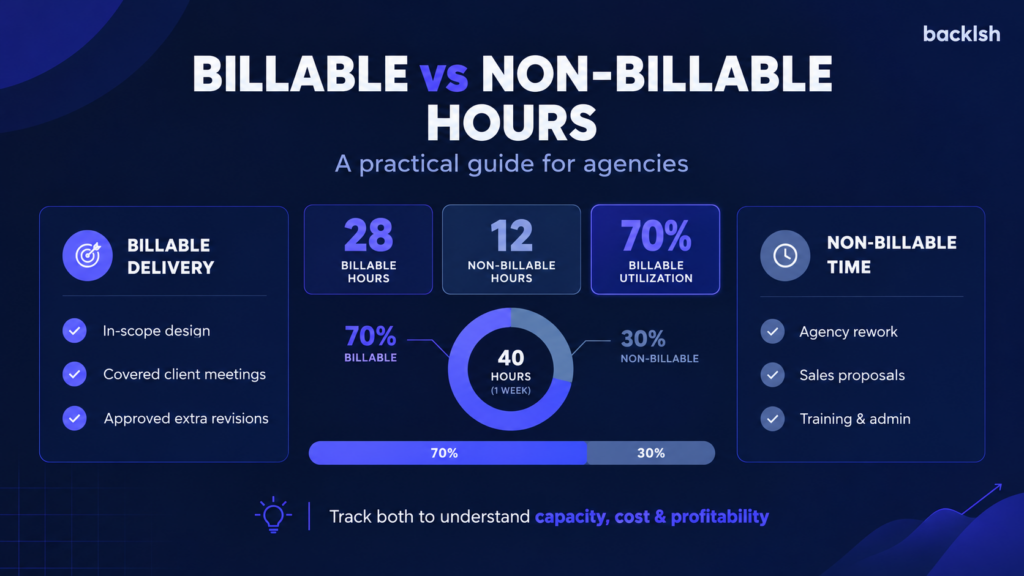
Billable hours are work your client agreement permits you to charge or allocate to an agreed fee. Non-billable hours are work that does not produce a separate charge under that agreement. Record both to understand delivery effort and capacity.
The activity name alone does not decide the category. A strategy meeting can be billable delivery on one engagement and pre-sale work on another. Use a written classification policy and resolve exceptions before invoicing.
Which agency activities are billable?
| Activity | Usually investigate this question | Suggested record |
|---|---|---|
| Client workshop | Is it an agreed deliverable? | Client, project and workshop purpose |
| Research | Does it support the contracted work? | Deliverable and research topic |
| Client email | Does the fee or hourly agreement cover coordination? | Project and communication purpose |
| Revisions | Included round, approved extra scope or agency rework? | Revision category and approval reference |
| Onboarding | Paid project setup or pre-sale qualification? | Engagement stage |
| Proposal writing | Is discovery chargeable or part of sales? | Sales or paid discovery project |
| Internal training | Is it internal development or contracted client training? | Training category |
| Administration | Is it overhead or an expressly agreed service? | Internal category or agreement reference |
These are classification prompts, not universal billing rules. The client agreement and approved scope control the charge. Employees’ pay obligations are separate from whether the agency can recover that time from a client.
How do hourly, fixed-fee and retainer models differ?
- Hourly: approved chargeable time is multiplied by the agreed rate, using any contractually permitted billing increment.
- Fixed fee: the fee remains tied to the agreed deliverable. Delivery hours reveal effort and profitability even when they do not appear as invoice lines.
- Retainer: track delivery against the allowance or scope. Overage charges and rollover require the terms specified in the agreement.
Define how your reporting labels in-scope fixed-fee delivery. In this guide, it counts as billable delivery for utilization, while excess unrecovered work stays separately visible. This is a reporting convention, not permission to charge extra.
Harvest’s project-type documentation illustrates why hourly and fixed-fee reporting need different treatment. Confirm the definitions in whichever system you use.
Worked example: one week of agency time
Assume one person has 40 available hours and all time has been recorded. The client agreements support the classifications below.
| Work category | Hours | Treatment |
|---|---|---|
| In-scope design | 22 | Billable delivery |
| Covered client meetings | 4 | Billable delivery |
| Approved additional revision | 2 | Billable delivery |
| Unrecovered agency rework | 3 | Non-billable delivery |
| Sales proposals | 4 | Non-billable sales |
| Training and administration | 5 | Non-billable internal |
| Total | 40 | 28 billable / 12 non-billable |
Billable utilization is 28 ÷ 40 × 100 = 70%. The 12 non-billable hours are not automatically waste. Sales and training can support future delivery; rework may require a different improvement plan.
If the rework is hidden inside a generic internal category, the agency may underestimate the client’s total delivery cost. Use project-linked non-billable categories when the extra work relates to a specific engagement.
How does non-billable work affect effective revenue?
Include all associated delivery hours when reviewing a client’s economics, even when some cannot be charged. Keep sales or general overhead treatment consistent with your costing policy.
Illustrative example: an engagement produces $4,000 of revenue and takes 40 delivery hours, including 10 unrecovered hours. Revenue per delivery hour is $4,000 ÷ 40 = $100. Dividing only by the 30 chargeable hours would show $133.33 and conceal some effort. Neither amount is profit until costs are considered.
For the broader calculation, see agency utilization and profitability.
Create a classification policy your team can use
- Write a short definition of billable delivery for each billing model.
- List internal categories: administration, sales, learning and other necessary work.
- Separate project-related rework and out-of-scope requests.
- Specify who approves scope changes and uncertain entries.
- Retain actual durations and document billing adjustments separately.
- Review a sample of entries consistently across contributors.
A useful timesheet has two independent fields: what work was done and how it is treated commercially. Do not rewrite the task description just to make the billing status look acceptable.
What should happen when work is out of scope?
Record it against the client with a clear status such as “awaiting scope decision.” Ask the engagement owner to determine whether it is approved extra work, included service or unrecovered effort. An urgent request is not automatically an authorization to invoice.
Use the pattern to improve future briefs and change-control discussions. The solution may be clearer revision limits, better estimates or a different fee structure, rather than asking employees to classify more time as billable.
A weekly review checklist
- Confirm time records are complete and do not overlap.
- Review ambiguous categories and scope approvals.
- Compare recorded delivery with the agreed allowance.
- Identify repeated rework and client requests outside scope.
- Check the draft invoice against approved entries.
- Keep payroll, capacity and client reporting definitions separate.
Use our consultant timesheet guide for client reporting and our missed-time recovery workflow for incomplete entries. Automatic tracking can assist collection, but an application name cannot decide whether a contract permits billing.
Frequently asked questions
Quick answers to common questions.